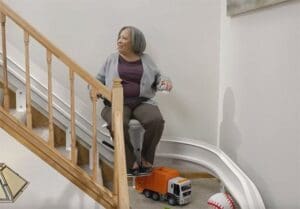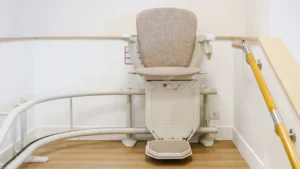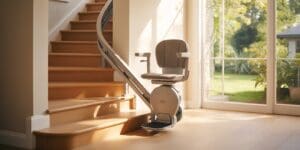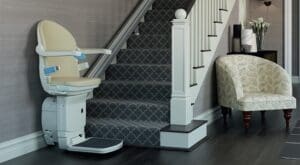
A curved stairlift costs around £5,500 installed in the UK, roughly double what a straight model runs. That gap surprises most people until they understand what’s actually being built. There’s no standard curved rail sitting in a warehouse waiting to be cut to length. Every single one is manufactured from scratch, to the precise geometry of one staircase, and that changes the economics completely.
Why Curved Costs More Than Double
A straight rail is stock material. An installer measures your staircase, cuts standard-length rail to fit, and fits it on the day. A curved rail starts with a surveyor taking a template of every angle, turn, and half-landing on your specific staircase. That template goes to a factory, where the rail is bent and welded to match it exactly. No two curved rails are the same, which means no economy of scale, and no shortcut on manufacturing time.
That single difference explains almost the entire price gap. Installation itself takes longer too, typically six to eight hours against two to four for a straight lift, because fitting a bespoke rail around landings and corners is inherently more involved than bolting a straight length to a run of stairs.
What You Can Expect to Pay
New curved stairlifts generally start around £4,500 and climb past £8,000 for staircases with multiple turns, half-landings, or unusual angles. The more complex the geometry, the more time the rail takes to manufacture, and the higher the quote. Reconditioned curved stairlifts bring that down considerably, typically starting from £2,500 to £3,000, though genuinely well-matched reconditioned rails for an unusual staircase shape can be harder to source than for a straight one.
| Factor | Straight | Curved |
|---|---|---|
| Average cost | £2,500 | £5,500 |
| Rail type | Standard length | Custom-manufactured |
| Installation time | 2 to 4 hours | 6 to 8 hours |
| Reconditioned availability | Widely available | Depends on matching your staircase |
Where your staircase sits on that spectrum, from one gentle turn to a full spiral with landings, is the single biggest factor in your quote. A stairlift with one 90 degree bend costs meaningfully less than one navigating two turns and a half-landing, even though both get called “curved” by installers.
What Actually Drives the Final Quote
Number and angle of turns
One 90 degree turn is the simplest and cheapest version of a curved staircase. Two turns, a spiral, or a staircase with an unusual angle rather than a standard right angle all push the rail manufacturing time up, and the price with it.
Half-landings and full landings
A half-landing part way up a staircase adds another dimension the rail has to negotiate, and typically adds cost. A full landing, common in split-level or bungalow-with-a-loft-conversion layouts, adds further complexity again.
Track length
Longer staircases mean more rail, more material, and slightly more manufacturing time, though this matters less than the number of turns. A long straight run with one gentle curve near the top is usually cheaper than a shorter staircase with two sharp turns.
Seat and rail finish
Standard fabric seats keep costs down. Leather upholstery, powered folding rails, swivel seats at the top of the stairs, and remote controls at both ends all add to the total, usually in the low hundreds per feature rather than thousands.
New Versus Reconditioned Curved Stairlifts
The gap between new and reconditioned is wider in percentage terms on curved models than straight ones, simply because the starting price is so much higher. A saving of two to three thousand pounds is common. The trade-off is availability. Because every curved rail is bespoke to one staircase, a reconditioned rail only works for you if your staircase shape happens to closely match the one it was originally built for. Installers sometimes need to adapt a reconditioned rail, which narrows the saving, or simply won’t have a suitable match in stock at all.
Our full breakdown of new versus reconditioned stairlifts covers warranty differences and what “reconditioned” actually means in practice, which matters more for curved models than straight ones given how much the rail geometry limits your reconditioned options.
Ways to Bring the Cost Down
VAT relief applies to curved stairlifts exactly as it does to straight ones. If you’re chronically sick or disabled, you pay 0 percent VAT rather than the standard 20 percent, which on a £5,500 curved lift saves £1,100 immediately, simply by completing a self-declaration form with your installer before you pay.
A Disabled Facilities Grant can cover some or all of the cost too, depending on a means test based on household income and savings. We’ve covered the full application process, including how the means test actually works, in our guide to stairlift funding and grants, which is worth reading before you commit to a full-price quote.
Getting three quotes matters more for curved stairlifts than straight ones, because the manufacturing and survey process leaves more room for installers to price the same job differently. Ask each installer to itemise the rail manufacture, installation, and any features separately, so you can actually compare like for like rather than comparing two opaque total figures.
Curved stairlifts are just one part of the picture. See our full stairlift costs guide to compare prices across straight, standing and rental options.
Ongoing Costs to Budget For
Annual servicing on a curved stairlift runs slightly above the straight equivalent, typically around £280 to £320 if paying separately, reflecting the extra time needed to check a rail with multiple moving sections and turn points. Most new curved stairlifts include servicing for the first two years, after which you either pay annually or take out an extended warranty. Running costs are negligible day to day. Electricity use is close to identical to a straight lift, working out to roughly £12 to £15 a year based on typical daily use.
Keeping up with servicing matters more on curved models specifically, since a rail with several turn points has more that can go out of alignment over time than a single straight length. Our guide to stairlift maintenance and servicing covers what a typical service actually involves and how often you genuinely need one.
Getting an Accurate Quote
Every figure in this guide is a starting point, not a quote. The only way to know what your specific staircase will cost is a home survey, which measures the exact angles and turns involved and accounts for anything unusual about your particular layout. It’s free, it takes about half an hour, and there’s no obligation attached to booking one. You can arrange a home assessment here.
Frequently Asked Questions
Why are curved stairlifts so much more expensive than straight ones?
The rail has to be custom-manufactured to match your exact staircase, with no two curved rails ever being quite the same. That bespoke manufacturing process, rather than the lift mechanism itself, accounts for most of the price difference.
Can I get a reconditioned curved stairlift?
Sometimes, though availability depends on finding a rail that closely matches your staircase’s specific shape. It’s worth asking installers directly what they currently hold in stock, since this varies far more than it does for straight stairlifts.
How long does a curved rail take to manufacture?
Typically a few weeks from survey to delivery, though this varies by manufacturer and how complex your staircase geometry is. Ask for a realistic lead time at the quote stage if timing matters to your decision.
Does VAT relief apply to curved stairlifts?
Yes, in exactly the same way as straight stairlifts. If you’re chronically sick or disabled, you pay 0 percent VAT rather than 20 percent, simply by self-declaring with your installer before purchase.